
Leveling the Playing Field – Thoughts on Parental Leave
Given the current climate for women and reproductive rights in this country, it remains imperative that as representation of women in neurosurgery increases, we continue to advocate for policies that acknowledge and support the unique challenges for women in the field. While we have made tremendous gains in changing the demographic landscape of neurosurgery, the cultural changes often lag behind, and perceptions surrounding women and childbearing are no exception. Despite growing public and ideological institutional support for women in health care, there remains tremendous variability in policies surrounding parental leave across the practice landscape.
For me personally, during residency I planned my family around what would be least disruptive to those around me, using my research years to minimize any effects of my decreased productivity. I took four weeks of leave after my C-section before returning to work, even though my program and mentors would have unquestionably supported my taking more. At the time, pushing myself, my body and my family was central to who I believed I needed to be to be taken seriously, to be a good co-resident and to succeed. In retrospect, I lost out on valuable and irreplaceable time with my first child. I spent the first year of his life as a chief resident, seeing him often for minutes a day or every other day, and missing nearly every milestone. This experience was so harrowing that I felt completely unprepared to have a second, and waited another five years until I was established as a practicing faculty member before having another. This time, while I planned to be back after six weeks, my physical recovery after surgery was far slower, forcing me to reconsider why I was pushing myself, at risk to myself and my child. I ended up taking five months of leave, thanks to a “bonding” policy at my institution, and am so grateful for the forces that shaped this decision. I was able to bond with my newborn in an entirely different way, and truly enjoy her transformation those first few months. I never allowed myself to think about what I might have been missing with my first, but were I to do it again, I would unquestionably have taken more. While I am grateful that I had the option of taking up to six months off as an attending, what would have been even better would have been if my husband (also a surgeon) and I each had three months off, allowing both of us to experience the joys of parenthood. Instead, my husband did a surgery the day after my son was born, and was given a paltry one day of leave after we welcomed our daughter. If paternal leave became the expectation, or even the mandate, regardless of gender, it would fundamentally eliminate one of the largest inequities between men and women in our field. If women cannot physically afford not to take leave after having a child, why not mandate that men take the same leave to support their family?
Specifically, pregnancy and the looming inequities surrounding parental leave acts to both discourage women from applying to the field, and can contribute to unconscious bias in hiring and promotion during childbearing years. Thanks to the work of some of our own WINS leaders, this issue has been studied and published to highlight the challenges we continue to face. In their study, Gupta et al. (2020)1 conducted an online survey examining the experience of female neurosurgeons with respect to pregnancy and perceived barriers to childbearing. Their results were remarkable, if not surprising. While obstacles such as perceived discrimination by coworkers (77% of women planning to have children) require ongoing cultural change to overcome, there are many immediate obstacles that can be ameliorated. A total of 92% of women who planned to have children were concerned about insufficient time to care for newborns, a concern validated by the fact that only 35% of participants reported their institution had a formal policy for family leave. Simple policy changes such as standardizing parental leave, with clear policies regarding time, compensation and support, can have enormous impact on family planning efforts and perceptions of inequity in neurosurgery. Similar changes in the business and financial industry have been met with tremendous success, leading to increased recruitment and retention of talent in the field. Studies have shown that companies that offer increased parental leave benefits reported higher rates of retention, advocacy and effort from their employees, with a corresponding increase in morale and productivity2. The bottom line is that standardized, extended paid parental leave is not only good for individuals, it is good for business. These lessons can and should be adopted without delay by the medical field, particularly in specialties with a poor track record of female representation.
While inadequate time for completion of boards was cited as an obstacle, the ABNS typically grants an extension upon request, often in excess of the FMLA time taken, and supports leave during residency. On a personal note, during my maternity leave, I used those rare hours my newborn was sleeping to work on my Boards submission and preparation, which helped me stay up-to-date when I returned to work. Had I needed it, I would not have hesitated to ask for an extension – the team at the ABNS is incredibly approachable and understanding. Having said that, the time is ripe for change and clear policies which allow women to make educated decisions and plans, without variability based on personal choices surrounding leave. In the academic community, promotion and tenure often accommodate women with an automatic year extension for each relevant deadline upon birth or adoption of each child. This clear and transparent policy reflects an understanding of the magnitude of the impact childbearing has on career development, and demonstrates an effort to level the playing field.
At the end of the day, it is up to us to advocate for these changes, and bring awareness to the persistent obstacles which limit more rapid growth of our field. We need to translate good intentions and theoretical support into substantive, standardized policy changes to help parents plan their careers and level the playing field. The most successful companies have realized that supporting women and families is a winning strategy – it is time for the neurosurgery community to come together to optimize parental leave policies.
By
Rupa Gopalan Juthani, MD, FAANS


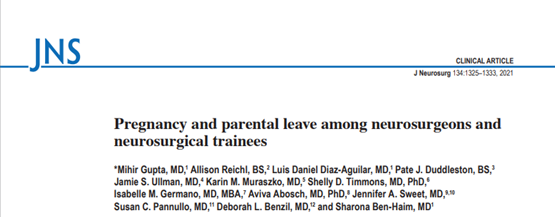
- Gupta et al. Pregnancy and parental leave among neurosurgeons and neurosurgical trainees. J Neurosurg 134: 1325-1333, 2021.
- Ward, Margaret. One chart shows why more companies should invest in paid parental leave. Business Insider, online edition, Dec 2, 2020. Accessed 8/23/2022