At the last Tumor Section meeting at both the AANS and CNS, it was unthinkable that having a meal or drink with a group of colleagues would be a far more complex endeavor in 2020. As a result of the global COVID-19 pandemic, in-person conferences worldwide ranging from daily rounds to international meetings have been transformed. Webinars, which once stood at the periphery education, have become the signature avenue for neurosurgical knowledge exchange. In our neurosurgical world, global barriers were being broken well before the COVID-19 pandemic as some of our members were already making use of digital resources for both communication and showcasing academic work. Nonetheless, the pandemic served as a catalyst to expand use of this technology to all members. The neuro-oncology community has been noted to be particularly adept at digital enterprise, as the plethora of consistent web series from many academic centers has not only continued but also strengthened educational content. Streaming on multiple social media platforms has facilitated progress and this welcomed change has become a powerful tool in the academic neurosurgeon’s armamentarium.
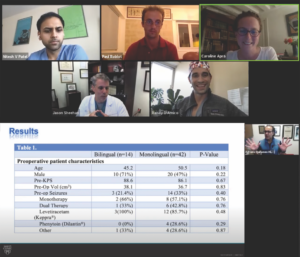
The Journal of Neuro-Oncology’s (JNO) Editor-in-Chief Jason P. Sheehan, MD, PhD, FAANS, and Lenox Hill’s Randy S. D’Amico, MD, have met significant success with their weekly Tumor Talk series. This webinar was initially developed by Dr. D’Amico as a recurring resource for neuro-oncology patients during the COVID-19 pandemic’s early months in New York City. As COVID-19 numbers began decreasing in Manhattan, Dr. D’Amico realized the power of the medium and reached out to the JNO. The webinar was reinvented as a platform on which authors of recent JNO articles could present their work. The series is through Zoom and with the significant contributions of Nitesh V. Patel, MD, is simultaneously livestreamed onto YouTube and Instagram with auto-archiving. The JNO and Lenox Hill Neurosurgery YouTube channels, along with the Lenox Hill Neurosurgery Instagram account, reach 25,000+ followers. The wide-net reach allows authors of JNO papers to present their work to colleagues and take questions from a live web audience that includes students, patients and colleagues. Authors discuss the rationale, results and clinical relevance of their presented work. Sessions are streamed weekly, lasting 30 minutes. Tumor Talk has now been broadcasting for four months and has featured Tumor Section members from around the world.
Neurosurgery training programs across the country have deployed web-based content for both marketing and education of not only their own residents, but also the community at large. The University of Miami’s neurosurgery program, led by chairman Allan D. Levi, MD, PhD, FAANS, co-chairman Jacques Morcos, MD, FAANS, has led this virtual movement with a social media storm. The Miami Global Brain Tumor Symposium (MGBTS) has become the model virtual brain tumor conference. With expert global speakers and panelists, the course director, Michael E. Ivan, MD, FAANS, and co-directors Ricardo J. Komotar, MD, FAANS, Dr. Morcos, and Carolina Benjamin, MD, have been able to virtually unite leaders in the field. These efforts have been instrumental in reshaping the educational footprint in surgical neuro-oncology. Information from the frontiers of brain tumor management is presented through an interactive case review format. More than 60 brain tumor neurosurgeons from around the world in have been featured in the last six months. In an effort to expand educational content to trainees, the University of Miami has initiated the Skull Base & Cerebrovascular Symposium, utilizing a debate type format, along with a Resident Hour focusing on what it takes to become a neurosurgery resident. The social media tools built into Instagram, Twitter and YouTube have led to 5,000+ neurosurgery provider followers.
Groups such as the Society for Neuro-Oncology (SNO), World Federation of Neurosurgical Societies (WFNS), and AANS/CNS committees have transformed their annual meetings into an online format. Admittedly, this change may have been strange for many as the virtual meeting process is not something that was historically significant. Nonetheless, the learning curve has been surmounted quickly. The recent efforts of SNO, WFNS, the AANS and CNS, have made it clear that large scale conferences can be successfully livestreamed entirely on a virtual platform. Participants are able to seamlessly attend and interact in these events from the comfort of their home or office with simply their mobile device.
The Tumor Section’s Executive Committee (EC) also had to adapt to this new reality. On September 12, 2020, the EC had its first large scale virtual meeting, led by Jason P. Sheehan, MD, PhD, FAANS, and organized with the help of Drs. Patel and D’Amico of JNOs Tumor Talk platform. The meeting was a success and members were easily able to review minutes, discuss new agenda items, and provide feedback.
With the world facing a problem like no other in modern history, academic neurosurgery has evolved to continue pushing the envelope. By taking advantage of trending virtual platforms, powerful social media tools and a sense of community, our neurosurgical colleagues are closer than ever. The efforts of our Tumor Section’s members have been incredible and serve as a model for other fields to follow. Together, we will rise from this pandemic as a stronger force, better equipped to educate each other and, most importantly, care for our patients.