
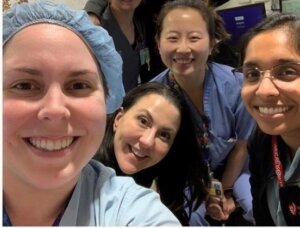
 At Case Western Reserve University, the history of women in neurosurgery runs deep. The program has a long history of graduating female surgeons and the trend continues. Currently, the program has 5 female residents along with 4 female faculty members. Additionally, several of the female neurosurgeon faculty members are active in the Women in Neurosurgery (WINS) community. The current female resident complement includes Sophie Zhou (PGY-5), Dana Defta (PGY-3), Olindi Wijesekera (PGY-3), Theresa Elder (PGY-2), and Kerrin Sunshine, one of our newly minted interns.
Neurosurgical training is one of the most rigorous in medicine, but the feeling that one is not alone makes it that much more manageable. I feel it is comforting to know that my female colleagues have my back. We go through a lot on a daily basis in neurosurgery- tough surgical cases, critical decision making, long and strenuous hours. It is nice to have female colleagues to relate to, even if it’s just to joke about how thankful we are for a reliable dry shampoo. In all seriousness, female colleagues were something I sought out when deciding on a residency program, as there is an unspoken bond between women in this male dominated field. At the end of the day, having female connections allows us as residents to feel more at home and more at ease amongst the team.
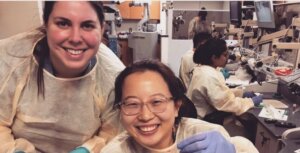 A network of strong women allows us to advocate for ourselves in a more cohesive and powerful way. Sophie regards that “one of the best things about working in a department with so many faculty and residents who are women is having a role model who looks like you! Representation and being able to envision yourself in that future position makes it all seem so much more possible and achievable. I’m very grateful to the women I work with for inspiring me everyday!” By having female role models, residents can feel validated and confident in their roles.
When Kerrin thinks about how being a woman impacts her role as a resident, she remarks “I really don’t think about my gender on a day to day basis with my colleagues, which I recognize, is a privilege. It’s also a testament to many many people. It’s a testament to both the female and male current leaders of our program, the members of the program, and those who have paved the way for us.” A strong group of women at multiple levels in neurosurgery allows for a collaborative and inclusive environment. We are so grateful to those who have come before us for creating a more diverse and robust specialty, and the importance of expanded female representation in neurosurgery cannot be overstated.